
The quote-to-cash process is every step between a customer asking for a price and the money arriving in your account, including paying the rep who sold it. It is commonly shortened to Q2C.
For a reseller or distributor, that sequence runs: quote, catalog pricing, order, fulfillment and vendor purchasing, invoice, payment, commission, and reporting. Most teams run it across three or four disconnected tools. Quote-to-cash software exists to run it in one.
This guide walks the full cycle as a reseller actually experiences it, which is different from how nearly every article on this subject describes it.
If you are weighing software categories rather than process stages, the companion guide, Quote-to-Cash vs CPQ vs Commission Software, covers where each one starts and stops.
Why Most Quote-to-Cash Guides Do Not Apply to You
Search this topic and you will find material written for subscription software companies. It talks about proration, renewal uplift, recurring billing schedules, and revenue recognition. It assumes the company sells its own product on a repeating contract.
A reseller sells someone else’s product, once, at a margin. The mechanics are not similar. Three things matter to a reseller that subscription-focused guidance never covers:
- Supplier and contract pricing. The right price depends on which contract the customer buys under, not on a pricing tier you set.
- Vendor cost per line. Margin is sale price minus what the supplier charged, calculated line by line, not modeled as a gross margin percentage.
- Commission timing. When the rep gets paid relative to when the customer pays is a cash flow decision, and on resale margins it is a significant one.
Everything below is written with those three in mind.
The Quote-to-Cash Process Flow, Stage by Stage
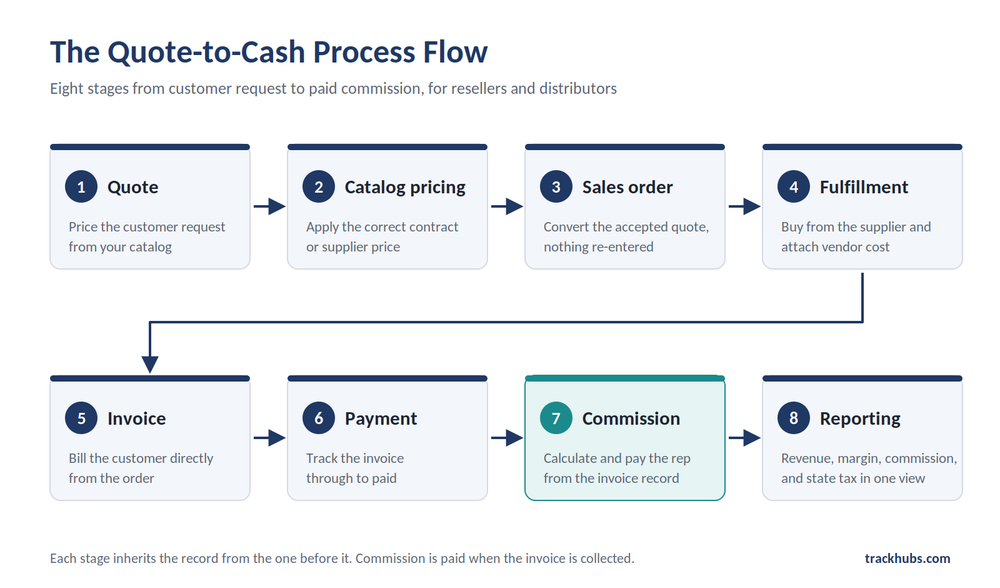
|
Stage |
What happens |
What breaks when it is manual |
|
1. Quote |
Price a customer request from your catalog |
Stale pricing, inconsistent quotes between reps |
|
2. Catalog |
Apply the correct contract or supplier price |
Wrong contract rate applied to a whole order |
|
3. Order |
Convert the accepted quote to a sales order |
Re-keyed quantities and line items |
|
4. Fulfillment |
Purchase from the supplier, attach vendor cost |
Margin becomes an estimate instead of a number |
|
5. Invoice |
Bill the customer from the order |
Invoice does not match the order |
|
6. Payment |
Track the invoice through to paid |
Aging invoices nobody is watching |
|
7. Commission |
Calculate and pay the rep |
Disputes, overpayment on deals that never pay |
|
8. Reporting |
Revenue, margin, commission, tax |
Month-end reconciliation across systems |
Stage 1: Quote
A request arrives, often as an email, a spreadsheet, or a supplier quote attached as a PDF. Someone turns it into a priced quote. This stage sets the accuracy of everything after it, because the order, the invoice, and the commission all inherit whatever the quote says. Good quoting and CPQ pulls line items from a catalog with pricing already attached rather than requiring them to be typed and looked up. TrackHubs’ AI Quote Builder starts from those same inputs, a supplier quote or a customer request uploaded or pasted, checks the lines against the catalog, and returns a draft quote for a person to review before it goes out.
Stage 2: Catalog and contract pricing
For a reseller, the price is not simply the price. It depends on the contract the customer is buying under. Resellers selling to government agencies need contract-mapped catalog and contract pricing alongside their commercial pricing, with SIN mapping for GSA Schedule holders, and the correct designation has to land on every line.
This is the stage that general CPQ tools built for subscription pricing handle poorly, because they are designed to configure a product rather than to look up an entitled price.
Stage 3: Order
The accepted quote becomes a sales order. In a connected system this is a conversion rather than a re-entry, so line items, quantities, pricing, and ship-to details carry forward untouched. Sales order management matters here because a quantity typed wrong at this point flows into the vendor purchase order, the invoice, and the commission calculation before anyone notices.
Stage 4: Fulfillment and vendor purchasing
The distributor or reseller buys from the supplier to fulfill. Vendor cost attaches here, which is the moment margin becomes calculable rather than assumed. Teams that skip this step in their system end up reconstructing margin from supplier invoices at month-end, which is both slow and unreliable.
Stage 5: Invoice
The order becomes an invoice. Again a conversion, not a retype. The most common failure in manual invoicing and billing is an invoice that does not match the order, which the customer catches, disputes, and delays paying.
The second most common failure is simply sending it late. Every day between fulfillment and invoicing is a day of delayed cash for no commercial reason.
Stage 6: Payment and collection
The invoice is tracked to paid. Automation here is unglamorous: status tracking, aging visibility, and reusable reminder templates. It is also where most of the recoverable cash sits in a small reseller, because invoices do not go unpaid so much as unchased.
Stage 7: Commission
The rep gets paid. Commission management calculates the payout from the invoice, which means the commission figure is derived from the same record as the revenue rather than from a parallel spreadsheet.
Whether payout is triggered by booking or by collection is covered below, because it is the single decision on this list with the largest cash flow consequence.
Stage 8: Reporting
With every stage sharing one record, reporting stops being an assembly job. Built-in reporting across revenue, margin, commission, and state tax becomes a filter and an export rather than two days of reconciliation.
Where the Process Leaks Margin
Revenue leakage in a manual quote-to-cash cycle comes from a small, repeating set of causes. None is dramatic, which is why they persist:
- Wrong contract price at the quote stage. Applied once, inherited everywhere downstream.
- Order-to-invoice mismatch. A line item that changed in transit between systems.
- Late invoicing. Pure cash flow cost with no offsetting benefit.
- Unchased receivables. Aging invoices that nobody owns.
- Commission overpayment. Reps paid on bookings for orders that later shrink, get returned, or never pay.
- Margin drift. Supplier cost rises, quoting does not catch up, and nobody sees it until month-end.
None of this is theoretical. At Sterile Services Co., the distribution company where TrackHubs was built and first used, a commission-tracking gap once meant paying commission on revenue that was never collected. That single gap cost roughly $4,100, and it is part of why the platform derives commission from the invoice record rather than from a parallel spreadsheet.
The commission timing decision
Paying commission when a deal books means paying out before the customer has paid you. On resale margins, that inverts the cash cycle: money leaves before it arrives, and the gap is funded by the business.
Paying on collection, where the rep is paid only when the cash lands, keeps payout aligned with inflow. It also removes most commission disputes, because the trigger becomes an objective event rather than a matter of interpretation.
Neither model is universally correct. Booking-based payout motivates faster closing and is common where collection risk is low. Collection-based payout protects cash and is the safer default for a business with thin margins and long payment terms. The decision should be deliberate rather than inherited from whatever the spreadsheet did.
What to Fix First
If you are moving off a manual process, sequence matters more than people expect. Fixing stages in the wrong order produces effort without much return.
- Quoting from a catalog. Highest accuracy gain for the least disruption, and every later stage inherits the improvement automatically.
- Quote to order conversion. Removes the first re-entry point in the cycle.
- Order to invoice conversion. Removes the second, and usually pulls invoicing forward by several days.
- Vendor cost capture. Makes margin a field rather than a month-end calculation.
- Commission calculation. Straightforward once invoices are structured data.
- Reporting. Largely arrives for free once the stages above share one connected system.
The common mistake is starting at the bottom of that list. Dashboards built on a disconnected process produce confident-looking views of unreliable numbers.
Frequently Asked Questions
What is the quote-to-cash process?
Quote-to-cash is the end-to-end business process running from a customer quote through order, fulfillment, invoicing, and payment collection, and in most definitions through sales commission payout as well.
What does Q2C stand for?
Q2C is the standard abbreviation for quote-to-cash. It is sometimes written QTC. Both refer to the same process.
What are the steps in the quote-to-cash cycle?
For a reseller or distributor: quote, catalog and contract pricing, sales order, fulfillment and vendor purchasing, invoice, payment collection, commission, and reporting. Subscription businesses substitute contract activation and recurring billing for the fulfillment and vendor stages.
Is quote-to-cash the same as order-to-cash?
No. Order-to-cash is a subset. It starts once an order exists and does not cover how the quote was built or priced. Quote-to-cash begins at the customer request.
How is the process different for resellers than for SaaS companies?
Resellers price from supplier and contract catalogs rather than their own pricing tiers, carry vendor cost on every line, and sell one-time rather than on a recurring contract. Subscription concepts like proration and renewal uplift do not apply.
Does the process change when selling to government agencies?
The stages are the same, but catalog and contract pricing carries more weight, since contract-mapped pricing (and SIN-mapped pricing for GSA Schedule holders) has to be correct on every line, and an audit trail of every action is generally expected.
See the Full Cycle Run in One System
The fastest way to judge whether a connected quote-to-cash process would change anything for your team is to watch one order move through it: quoted from a catalog, converted to an order, invoiced, and the commission paid when the cash lands. Book a demo and see it run end to end against the way your team sells today.
Prefer to try it yourself first? Start a free trial and run one of your own quotes through it.