
These three categories get compared as though they were competing answers to the same question. They are not. Each one covers a different stretch of the same process, and the useful comparison is about where each one starts and stops.
The short version: CPQ ends when the quote is sent. Commission software begins after the sale is recorded. Quote-to-cash spans both and everything in between. Buy the wrong one and you have automated a segment while leaving a manual handoff at its edge, which is where the reconciliation work reappears.
The Three Categories at a Glance
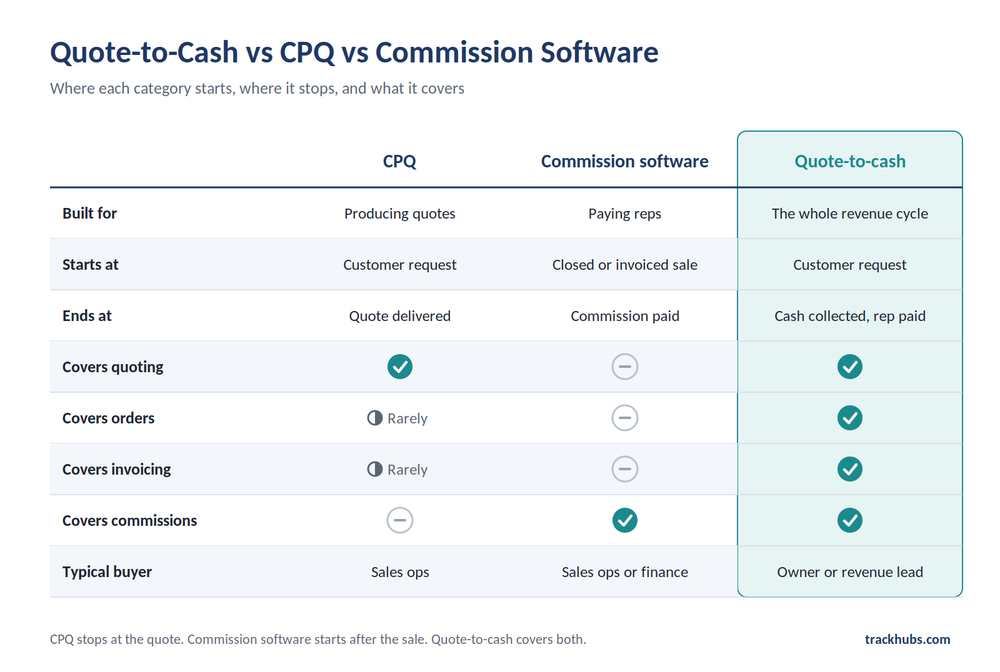
|
|
CPQ |
Commission software |
Quote-to-cash |
|
Built for |
Producing quotes |
Paying reps |
The whole revenue cycle |
|
Starts at |
Customer request |
Closed or invoiced sale |
Customer request |
|
Ends at |
Quote delivered |
Commission paid |
Cash collected and rep paid |
|
Covers quoting |
Yes |
No |
Yes |
|
Covers orders |
Rarely |
No |
Yes |
|
Covers invoicing |
Rarely |
No |
Yes |
|
Covers commissions |
No |
Yes |
Yes |
|
Typical buyer |
Sales ops |
Sales ops or finance |
Owner or revenue lead |
Category 1: CPQ, or Configure, Price, Quote
CPQ software exists to turn a customer requirement into an accurate priced quote. It handles product configuration, pricing rules, discount approvals, and quote document generation. Strong quoting and CPQ capability is genuinely valuable, and for businesses with complex configurable products it is indispensable.
Where it stops: the moment the quote goes out. CPQ does not tell you whether the order was fulfilled, whether the invoice went out, whether the customer paid, or what the rep is owed.
The reseller caveat: most CPQ tools are built around configuring a product you own, with pricing rules you define. A reseller is doing something different, which is looking up an entitled price on a specific contract. That is a catalog lookup problem, not a configuration problem, and general-purpose CPQ handles it unevenly.
Category 2: Sales Commission Software
Commission software calculates what reps have earned and manages the payout. It handles plan rules, quota attainment, splits, tiers, accelerators, and statements. Dedicated commission management tools are good at the part they own, and for teams with complicated plan structures they replace a genuinely painful spreadsheet.
Where it starts: after the sale exists. Commission software takes closed deals or invoices as an input, usually via an integration with a CRM or an accounting system. It does not produce the quote and it does not invoice the customer.
The reseller caveat: most commission tools calculate on bookings, because they are designed for businesses where collection is near-certain. Commission triggered by cash collection rather than by booking is often either unsupported or awkward to configure.
Category 3: Quote-to-Cash
Quote-to-cash software covers the full span: quote, catalog pricing, sales order management, fulfillment, invoicing and billing, payment collection, commission, and reporting across all of it.
The argument for it is not that it is better at any single stage than a specialist tool. A dedicated CPQ platform will out-configure it, and a dedicated commission engine will handle more exotic plan structures. The argument is that the handoffs disappear.
That matters because the handoffs are where the cost is. Every point where data moves between systems by hand is a point where a quantity gets mistyped, an invoice diverges from an order, or a commission is calculated from a number that no longer matches the invoice.
A note on order-to-cash
Order-to-cash software is sometimes offered as a fourth option. It is a subset of quote-to-cash: it assumes an order already exists and covers fulfillment, invoicing, and collection. It does not cover how the quote was built or priced, which for a reseller is where accuracy is won or lost.
Frequently Asked Questions
Is CPQ part of quote-to-cash?
Yes. CPQ is the first stage of the quote-to-cash process. Quote-to-cash continues through order, invoice, payment, and commission after CPQ has finished. For the full stage-by-stage sequence, see The Quote-to-Cash Process for Resellers and Distributors.
Can I just use CPQ and a commission tool together?
You can, and many teams do. It leaves a gap in the middle covering orders, invoicing, and payment collection, which usually gets filled by accounting software and a spreadsheet. Whether that is acceptable depends on how much reconciliation work the gap creates.
Is order-to-cash the same as quote-to-cash?
No. Order-to-cash begins once an order exists. Quote-to-cash begins at the customer request and includes quoting and pricing.
Does quote-to-cash software replace accounting software?
Generally no. It produces invoices and tracks payment, and typically integrates with an accounting package for the books themselves. Treat it as connected to accounting rather than a replacement for it.
Which category handles commission paid on collection?
Commission software can sometimes be configured for it, but it is more commonly a feature of quote-to-cash platforms, because triggering payout on collection requires the invoice and payment data to live in the same system as the commission calculation.
Choosing Between Them as a Reseller or Distributor
The general comparison above applies to any business. Four criteria matter disproportionately if you resell or distribute:
Contract catalog pricing
If you sell to government agencies alongside commercial buyers, you need contract-mapped catalogs (SIN-mapped as well, if you hold a GSA Schedule) with the correct designation applied on every line. Evaluate this before anything else, because a tool that cannot price your contracts correctly cannot be used regardless of its other strengths.
Vendor cost held against sale price
Margin on a resale transaction is per-line sale price minus supplier cost. If the system does not hold both, margin remains a spreadsheet exercise no matter how much else is automated.
Commission timing
Decide whether reps are paid on booking or on collection before you shortlist, because it eliminates options. Commission paid on collection keeps payout aligned with cash inflow, which matters more the thinner your margins and the longer your payment terms.
Reporting and audit trail
Government contracting brings an expectation that every action is logged and exportable. Separately, reporting across the full cycle is only possible when the stages share one record, which is a structural property of the category you pick rather than a feature you can add later.
Which One Fits You
A reasonable way to decide:
- Choose CPQ alone if quoting is genuinely your only bottleneck, your products are complex to configure, and invoicing and commissions are already handled well elsewhere.
- Choose commission software alone if quoting is simple, your commission plans are complicated, and you already have reliable order and invoice data feeding it.
- Choose quote-to-cash if the same information is being entered more than once, if month-end reconciliation is a recurring cost, or if commission disputes keep surfacing. Those three symptoms all point at handoffs rather than at any single stage.
If you land on the third, compare on scope rather than on feature count. The question is whether a single connected platform covers every stage you actually run, and a plan and module breakdown is usually a faster way to answer that than a feature list.
The wrong reason to buy any of the three is that a stage feels slow. The right reason is that the seams between stages are costing you money you can name.
Not Sure Which Category You Need?
If the seams between quoting, invoicing, and commissions are where your time goes, the scope question is easier to answer by watching one order run the whole cycle than by comparing feature lists. Book a demo and bring a real quote you would normally build by hand. Bring the file itself, too: the AI Quote Builder will turn it into a draft quote for review during the demo.
Prefer to try it yourself first? Start a free trial and run one of your own quotes through it.