
Sales commission software calculates what reps have earned and manages the payout, replacing the spreadsheet that usually does the job until it stops being reliable.
Most of what is written about it assumes a large software sales team: quota attainment, accelerators, SPIFFs, multi-tier plan design. If you run a small reseller or distribution business paying two or five people a percentage on what they sell, almost none of that applies, and the one decision that matters most to you is barely discussed.
That decision is timing. Not how much, but when.
What Commission Software Actually Does
At its simplest, commission management takes a record of what was sold, applies your commission rules to it, and produces what each rep is owed, along with a record of why.
That sounds trivial until you notice what the spreadsheet version requires. Someone has to copy the sale into the sheet, apply the right rate, check whether the deal was split, remember whether that customer pays on different terms, and then do it again next month with last month’s errors still in the file. The work is not arithmetic. The work is keeping the inputs correct.
What it calculates from
The commission is only as accurate as the records underneath it. In a connected system, the calculation reads directly from sales order management and invoice and payment records, which means the commission figure and the revenue figure come from the same place rather than from two files that can drift apart.
Those records inherit their accuracy from further upstream. Clean quoting and CPQ means the order carries the right line items and the right contract price, so the commission calculated at the end of the chain is built on a number nobody retyped.
The Decision That Matters: Booking or Collection
Most commission tools calculate on bookings, because they are built for businesses where collection is close to certain. The deal closes, the commission is earned, the payout follows shortly after.
For a reseller on thin margins with customers on net 30 or net 45 terms, that sequence inverts the cash cycle.
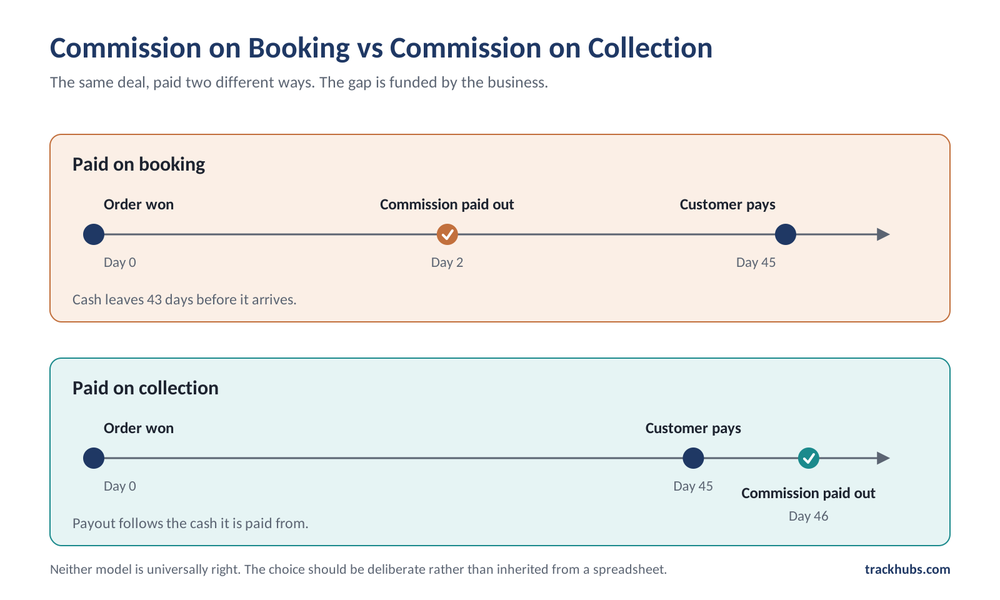
Paying on booking means money leaves the business before it arrives. The gap is funded by the reseller, every deal, every month. On a healthy margin that is an inconvenience. On resale margins it is a working capital problem that grows with sales volume, which is the cruelest version of the problem: the better the quarter, the tighter the cash.
Paying on collection, where the rep is paid only when the cash lands, keeps payout aligned with inflow. It also removes most commission disputes, because the trigger becomes an objective event, an invoice marked paid, rather than a judgment about when a deal counts as done.
The objection, and the answer
The reasonable objection is that reps should not carry the risk of slow-paying customers. That is fair, and it is worth saying out loud when you change the model.
The practical answer is that pay-on-collection gives the sales team a direct reason to care about collection. A rep who can see which of their own invoices are outstanding, and knows their commission is attached to them, will follow up with the customer in a way no finance reminder achieves. The incentive points the same direction as the business for once.
It is still a real change to how people get paid. Announce it in advance, apply it to new deals rather than retroactively, and make each rep’s own commission status visible to them so the rule feels like transparency rather than a delay tactic.
Commission on Margin, Not Just Revenue
The second thing general commission tools handle badly for resellers is the basis of the calculation.
A percentage of revenue is simple, and it quietly rewards discounting. A rep who drops the price to win the deal still earns on the full sale value while the margin absorbs the cut. Calculating on margin instead requires the system to hold vendor cost against sale price on every line, which most commission tools never see because they take a closed deal as their input rather than the underlying order.
Neither basis is automatically correct. Revenue-based plans are simpler to explain and work where pricing is fixed. Margin-based plans suit businesses where reps have pricing latitude. The point is that you should be able to choose, and that choice depends on whether your system knows what the product cost you.
Frequently Asked Questions
What is sales commission software?
Sales commission software calculates what each rep has earned from sales records, tracks what has been paid and what is outstanding, and keeps an auditable record of how each figure was reached. It replaces manual commission spreadsheets.
How do you structure sales commissions for a small team?
Keep it simple enough to explain in two sentences. Pick one basis, revenue or margin, set one rate or a small number of tiers, define when commission is earned and when it is paid, and write down how splits and returns are handled. Complexity added early tends to outlive its usefulness.
What is a good commission rate for sales?
It varies widely by industry, margin structure, and whether the role carries a base salary, so any single number would be misleading. The more useful question for a reseller is what percentage of gross margin, rather than revenue, you can sustainably give away while covering overhead.
How is sales commission calculated?
The basic formula is the commission base multiplied by the commission rate. The decisions that actually matter are what goes into the base, revenue or margin, and what event triggers the calculation, the order or the collected invoice.
What does pay on collection mean?
Commission is released only after the customer’s payment has been received, rather than when the order is booked. It protects cash flow and ties payout to an objective event.
Do small teams really need commission software?
Not always. One rep on a flat rate with reliable customers is manageable in a spreadsheet. The case strengthens quickly once there are several reps, split deals, variable terms, or a dispute that nobody can settle from the records.
What to Look For Before You Buy
Weighted for a small reseller rather than a large sales organization:
|
What to check |
Why it matters |
How to test it |
|
Where the data comes from |
Commission read from your own orders and invoices beats commission typed in or imported |
Ask to see the calculation trace back to a specific invoice |
|
Payout trigger |
Booking or collection is a cash flow decision, not a setting detail |
Ask whether collection-based payout is native or a workaround |
|
Commission basis |
Margin-based plans need the system to hold vendor cost |
Ask whether it can calculate on gross margin per line |
|
Rep visibility |
Reps chasing their own unpaid invoices is the point |
Ask what a rep sees when they log in |
|
Error controls |
Overpayments are hard to claw back once paid |
Ask how unusual payouts get flagged before release |
|
Audit trail |
Disputes end faster with a record of who changed what |
Ask to see the log for a changed commission |
|
Permissions |
Not everyone should see margin or other reps’ earnings |
Ask whether access is set per module |
None of this is theoretical. At Sterile Services Co., the distribution company where TrackHubs was built and first used, a commission-tracking gap once meant paying commission on revenue that was never collected. That single gap cost roughly $4,100, and it is part of why the platform derives commission from the invoice record rather than from a parallel spreadsheet.
Standalone tool or part of the cycle
A dedicated commission engine will handle more exotic plan structures than a broader platform will. The trade-off is that it starts after the sale exists, so it depends on an integration feeding it clean order and invoice data. If that data currently lives in a spreadsheet, the commission tool inherits the problem rather than solving it. Running commission inside one connected system avoids that handoff, and a plan and module breakdown is usually a faster way to compare scope than a feature list. In TrackHubs, commission management, including commission types and rates, earnings, payout status, and release as customers pay, is included from the Track Control plan and above.
For the full comparison of where each software category starts and stops, Quote-to-Cash vs CPQ vs Commission Software covers it in detail. If the broader problem is that nothing is tracked consistently yet, start with Sales Tracking Software for Small Business instead.
Fix the Timing First
If you change one thing about how your team is paid, make it the trigger rather than the rate. Rates get debated endlessly and rarely move the business. Timing decides whether a growing sales month strengthens your cash position or strains it.
See It Calculate From a Real Invoice
The fastest way to judge commission software is to watch it derive a payout from an actual invoice rather than from a number someone entered. Book a demo and bring a commission calculation you currently do by hand.
Prefer to try it yourself first? See pricing and save 50% for 3 months, and run one of your own orders through to commission.